Setting up a Marine Saltwater Aquarium
HOW DO I PROPERLY SET UP MY MARINE AQUARIUM
This guide is for setting up a FOWLR (fish only with live rock) aquarium, if you would like to know how to set up a coral or a more advanced saltwater aquarium check out the other guides.
Saltwater Aquarium Equipment Check List
- Aquarium - the larger the better
- Background - this completely depends on your preference and placement
- Saltwater Hydrometer - to measure the correct salinity of the water
- Thermometer
- Aquarium Filter - Cannister filters will work very well, so do all in one tanks
- Heater - With the correct wattage for your tank
- Substrate - crushed coral is a safe choice. Very fine sands can sometimes pose an issue
- Fish food - dependant on your choice of fish, tangs and other species can be vegetarian keep that in mind
- Live Rock - can be bought from you local fish store
- Protein skimmer - larger the better
- Aquarium Glass Scrubber
- 5 Gallon clean buckets
Before You Begin Checklist
- Is the floor is able to take the filled weight of the tank? Are reinforcements needed?
- Is the slope of the floor completely level? To prevent leakage this must be flat
- There are enough power points nearby and multiple power boards on hand. Is an extension lead needed?
- The tank is not situated within direct sunlight. Algae will otherwise be much harder to control.
- You enjoy the placement of the tank as moving it after setup is impossible.
- It is close to a bathroom/outdoor area for cleaning and saltwater changes.
Cost Involved
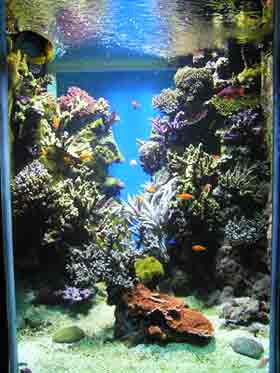
You must realize the large cost and effort involved with a salt water aquarium. Like any pet you will need to spend both money and time looking after it. If cost is a factor then beware, saltwater aquariums are far more expensive to set up than there freshwater counterparts, not to mention most saltwater fish carry a much higher price tag.
If you feel this is something you would like to do, it is recommended to spend time reading up on anything and everything related to marine aquariums. Research the fish you want, look at basic pointers, look at other people's downfalls. It is easy to make the same mistakes as everyone else but with a little research you can easily avoid these and this guide will walk you through the proper way of setting up your aquarium with hints and tips.
The Aquarium
You will want to purchase the largest one you can afford and care for. This is not only for stability but for aesthetics and changes in the future. If there is a specific type of fish you want in your aquarium, be sure to research how big it gets.
If it grows quite large you will obviously need a very big aquarium to house it, make sure your prepared to take that path. If you purchase a smaller tank have a look at the type of fish available, maybe there not as attractive as what you wanted?
A good rule is to try to purchase anything over 40 gallons, but with todays emerging technologies it makes keeping a smaller or even 'nano' marine tank very easy. Be sure to know what your doing if you choose a smaller tank, as they will be less consistent and you are more likely to run into larger problems.
Sump Filtration
You will need to purchase your basic equipment to start up your aquarium. With filtration, you will need a basic mechanical filter such as a sump or canister filter. The live rock will handle the majority of the biological process.
Sumps are growing rapidly in popularity and for good reason. They increase the tanks volume by a significant margin, something that will increase the stability of the water parameters but also allow you to house more fish and invertebrate.
An appropriate sump should fit neatly in the fish tank cabinet with room left for maitenance and essential equipment to one side. The sump should consist of up to 4 seperate compartments seperated by glass baffles in which the water either flows over or under.
Having the skimmer situated in an early compartment will reduce the chance of micro-bubbles making their way back into the aquarium and keeping high clarity within the display aquarium. The flow pipe into the sump should have an attatched filter sock to collect debris and protect the sump equipment.
The different sump compartments can contain a variety of mechanical and chemical filtration medias of your choice and research. Popular additions include a refugium, sand,
Canister filters are reccomended becuase of there low noise and energy consumption. They are quite easy to maintain and allow a high flow rate in the aquarium which is important in a marine aquarium. Other means of filtration will work but they can be more difficult and less effective.
Protein Skimmers
Protein skimmers are a very important part of the marine setup. Don't be cheap when it comes to buying a skimmer, a poorly made protein skimmer will release bubbles into the aquarium and sacrifice the display quality.
Buy the largest skimmer you can afford for your aquarium as efficiency is linear and the waste cup will need to be changed far less. They are essential to both fish only tanks and coral tanks by removing the excess waste and protein build up excreted by the fish and coral.
Live Rock
You will also need to buy live rock. Make sure you choose pieces that look very nice but also do not have too much living garbage on them. During the cycling process it is possible for the organisms to die on the rocks leaving an awful mess.
Another thing to look out for are mantis shrimp i can tell you i have had many in times past and they are so very annoying. Make sure you check ALL the holes in the rock you buy, if you are unsure or something may be living inside DON'T buy the rock. Mantis shrimp can easily crack the glass of your tank and are extremely hard to eliminate. They have also been known to kill fish.
Steps Involved From Start to End

Initial Setup of Tank and Substrate
- Clean out your aquarium with plain water, don't use soap or detergent! Make sure it is free from dust and foreign materials.
- If you have a background attatch it now with some tape or basic glue. Alternatively you can paint the outside of the aquarium keeping in mind this is a hard process to reverse.
- Unless you have purchased live or bacteria ready sand, before adding your substrate be sure to give it a solid rinse and wash to remove dust and fine particles that would otherwise pollute the water.
- Add your substrate to the tank, whatever it is, sand, crushed coral etc add it to the base of your aquarium making about a 1-2" thick layer. It does not have to be completely flat but there should be no places in which the glass is not completely covered.
- Position and set up your filter, light, skimmer, heater etc but do not turn any of these on. Be sure to create a drip look to prevent water running down the lines and ruining your circuits. A drip loop is basically a U shape before the power cord enters the wall. This will make it impossible for the water to reach the powerpoint and short expensive equipment.

Adding Saltwater
- Make up your salt water solution. Follow the directions on the packaging to make your premixed salt water. Remember it is always easier to add less and then add more later than the reverse. Alternatively you could fill your tank with real saltwater from the store, but this can be pricey and inefficient.
- To mix your salt water, place water in a bucket and add the salt. When the specific gravity between 1.022 and 1.026 is reached, you can add this water to the aquarium. Repeat this process.
- Make sure to add a DECHLORINATOR otherwise there will be a build up of chlorine and chloramine and your tank will never cycle.
- Turn on your filter and heater, letting the water flow for a few days.

Adding Live Rock
- This is the most important stage of setting up and will provide you with the valuable biological process that will keep your fish alive. Live rock can be very expensive so be sure to choose pieces of rock that you like.
- You should set up a powerhead to help in the curing and cleaning process of the live rock stage. This will contantly remove any rotting or unwanted debris.
- Place the live rock in the tank and leave it for a few days. Every few days turn off the filter and do routine maitenance, which consists of cleaning the rocks with a small haired brush to remove the dying creatures and replacing some of the water.

Cycling the Aquarium
- Your tank may have an unpleasant odour at this stage, but do not stress as this is only temporary. When it begins to lose that scent and smell like the ocean it will be almost cycled.
- After a few weeks, you should test the tank regularily for ammonia and nitrites. The tank will have noticeably been through a cycling stage.
- Anywhere from 2-8 weeks, once the ammonia and nitrites have reached values of 0 you can assume your tank is cycled. Proceed with caution as your tank has an insignificant bioload at this time, introducing fish and crustaceans slowly is advisable.
- Desired water parameters before adding fish should be:
- Specific gravity (should be between 1.021 and 1.024, measure with your hydrometer)
- Temperature should be between 75°F - 80°F (24°C - 27°C)
- Ammonia should be at 0!
- Nitrites should be at 0!
- pH should be around 8.0 - 8.4 (This does not usually need changing due to the rock and crushed coral changing the pH, but alternatively you can buy a pH buffer)
- Nitrate less than 20ppm (if its too high, throw in a water change)
- Carbonate hardness should be from 7-10 dKH
- Before adding fish be sure to check ALL your water parameters so you do not purchase something that will cause stress to the fish and potentially cost you unnecessary loss.
- Do the same for a canister filter and ensure the baskets are closely stacked and the top is tightly locked in place to prevent leaks.

Adding Fish
- After you have reached this stage you are able to add your fish! For a more detailed analysis on the possible types of fish and what will suit you best, look at the saltwater fishes page (coming soon). For now ocellaris clown fish are a great beginner fish. They are relatively hardy, extremely colorful and are a beautiful, lively addition to show off your prize aquarium.
- It is sensible to only add about 1 or 2 fish a each week. Be sure to properly aclimatize them by following these easy steps. Stocking your tank slowly will help the positive bacteria grow linearly with the bioload in your aquarium. It is advisable to only add one inch of fish per 5 gallons of aquarium water in your system.
- Allow the bag to float in the tank water for about to 10 minutes
- Open the bag and put one cup of tank water in the bag every 5 minutes
- After about three cups let the fish into the aquarium by using a gentle net as not to hurt its fins.
- Keep your fish and aquarium healthy by doing constant maitenance. You will need to change about 5% of the tanks water a week or 10% every fortnight to replace lost minerals and elements.
- Be sure to clean the glass and substrate from algae to give it that super shine. Use a razorblade or scrubber on the glass and manually clean the substrate to remove any residual algae.
- Be careful to not add freshly mixed saltwater to your tank, this can be caustic to the fish as the salt particles may have not completely disolved. Remember to clean out the filter media every fortnight (at least) from excess food and dying organisms.

Cycling
- At this point you will have to “CYCLE” the tank. This will promote the build up of de-nitrifying bacteria and is essential to setting up your new aquarium.
- It will prevent any unnecessary loss or death of the aquariums first inhabitants. Please follow the next part of the guide by following the cycling link below.
Congratulations!
Your saltwater FOWLR aquarium is now complete! Once set up properly should provide years of fun and enjoyment for yourself and the family or workplace. You will be suprised at the little effort needed to keep your new tank appealing and beautiful!